01 · Identity
Content-addressed storage
Names immutable objects from their canonical bytes, verifies reads, and reuses exact duplicates across files, layer stacks, and agents.
Press ← or → to navigate between chapters
Press S or / to search in the book
Press ? to show this help
Press Esc to hide this help

Filesystem Storage for Parallel Agents
01 · LayerStack storage model
CAS, CDC, and COW solve three different forms of reuse: object identity, byte locality, and structural locality.
01 · Identity
Names immutable objects from their canonical bytes, verifies reads, and reuses exact duplicates across files, layer stacks, and agents.
02 · Byte locality
Keeps chunk boundaries stable around localized edits, so changing a small region does not require storing an entirely new large file.
03 · Structural locality
Publishes a change in a new layer by rebuilding only the changed file and directory path while preserving every unchanged subtree from its parent.
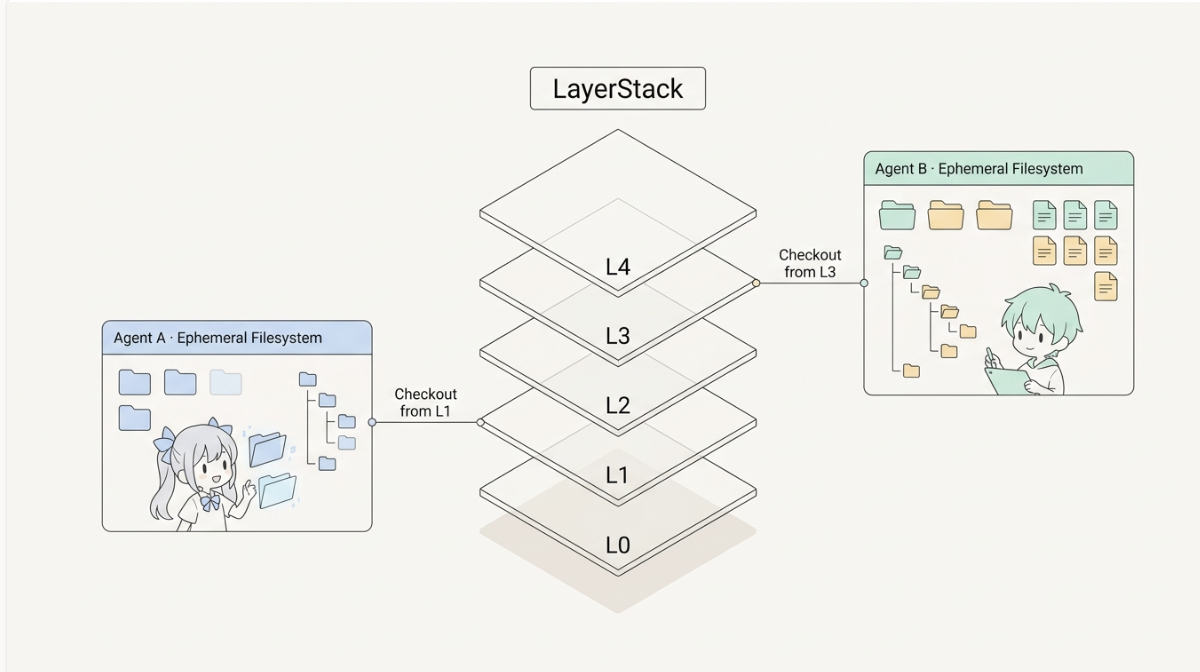
A LayerStack records a sequence of filesystem states. Agent A can check out an ephemeral filesystem from L1 while Agent B independently checks out another from L3, giving each agent a separate place to work from the state it selected.
02 · System boundaries
The storage engine is implemented today. The SDK and filesystem projection are the planned interfaces around it.
Owns identities, canonical objects, CDC, file manifests, structural COW, packs, immutable CAS admission, lifecycle coordination, and verified reads.
Will expose stable filesystem, workspace, layer-stack, and publication operations without leaking private CAS handles or storage formats.
Will expose a workspace to an agent and capture bounded filesystem effects. It delegates identity, CDC, COW, and admission to storage.
03 · Reading path
The book follows the same dependency order as the storage model: establish immutable content identity, localize file edits, optimize the combined representation, and only then add filesystem-level copy-on-write.
04 · Ecosystem
LayerFS supplies storage mechanics. The surrounding projects own execution environments and version-control workflows.
 DeltaGit
Version control for work in motion.
↗
DeltaGit
Version control for work in motion.
↗
 Ephemeral Sandbox
Isolated execution environments for parallel agents.
Ephemeral Sandbox
Isolated execution environments for parallel agents.
Powered by Ephemeral AI Lab